
The events below are in the process of being scheduled – updates will be announced on the list as they are confirmed.
The Critical Clinic
The critical clinic is a series of events that will address the psychic world as embedded in the social world with its various legacies. The critical clinic will serve to navigate a landscape of psychic devastations born of a world in a world of trouble.
Film Screening: Longing Suite
You are invited to a screening (on line) of Longing Suite, by Nicolás Grandi & Lata Mani (Video, 28 mins, 2026) with the opportunity to be in dialogue with the makers following the screening.
Gail Lewis, Shalini Masih, Lenya Samani and Robert Downes will each respond to the film.
Longing Suite is a meditative videopoem that traces the arc of a heart-mind-body awakening to the Feminine Divine and the sacred in all that exists. Grandi and Mani build on a cycle of poems written by Mani in the 1990s to continue their transmedia experiments in kaleidoscopic storytelling. Drawing aesthetic inspiration from the dynamics of the spiritual journey Longing Suite offers an evocative visual and sensorial experience at once individual and universal.
“In the clear and present danger of these times of genocide and violent degradation and assault on human, more than human life and the environments that sustain it all, the word, sound and visual poems of Longing Suite invite entry into forms of being and living based on the connection of all things. These are poems that facilitate surrender to the divine as act of remembrance and possibility even when all that poses as truth dismembers and desecrates. This is not to confuse the evocation of the blessed and divine with the evacuation of the material and structural but to say that surrender to the infinitude of love as the body expands into its folds of possibility is to engage in a mode of hope as practiced connection against all that would fracture and atomise. Longing Suite is an offering of radical love and potential and necessary balm in these times of war. Its gesture is to foster recognition of longing as bequeathed by the divine in the service of life, earthly and beyond earthly, alike. It calls across the boundaries of false certitude and fantasies of total command and invites entry into the unthought known of infinite becoming. It is a gift to be treasured!”
Gail Lewis, Psychoanalytic Psychotherapist. Black Feminist Theorist, Activist & Cultural Critic
“The textured weave of sound and image in Longing Suite…offers us the shiver of visceral experience. A swirl of images – implicating geographies both natural and cultural, and metaphors of diverse wisdom traditions – catapults us from faith as inheritance to firsthand encounter. We emerge not as bystanders, but as participants, stained by silence, altered by the windrush and stillness of this wild ride. Nicolás Grandi and Lata Mani’s hauntingly powerful film is both sacred arc and sensorium; pilgrimage and homecoming.”
Arundhathi Subramaniam, poet, writer.
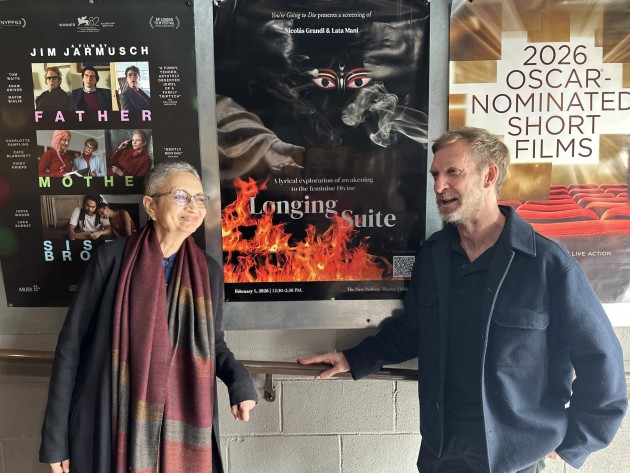
Lata Mani and Nicolás Grandi at Longing Suite premiere in Oakland, CA on February 1, 2026.
Lata Mani is a feminist historian, cultural critic, contemplative writer & filmmaker.
Lata’s films with Nicolás Grandi include The Poetics of Fragility featuring Angela Davis, Cherríe Moraga among others, De Sidere 7, The Earth on its Axis, We in Our Skin: The Tantra of Embodiment & the videopoems Here-Now and Nocturne I & II. She has also published on a broad range of issues, from feminism and colonialism, to illness, spiritual philosophy and contemporary politics. Her books include Myriad Intimacies, 2022, The Integral Nature of Things, 2013, Interleaves, 2011, SacredSecular, 2009 & Contentious Traditions, 1998. More at www.latamani.com
Nicolás Grandi is a Buenos Aires based filmmaker, transdisciplinary artist and educator.
Nicolás Grandi is a Buenos Aires based filmmaker transdisciplinary artist and educator. His work exists at the intersection of film, poetry, music, and sculpture, exploring the myriad possibilities in the relationship between images and words. His artistic practice questions disciplinary and formal boundaries with a special focus on facilitating transcultural dialogues. As an educator, he has delved into project-based learning methodologies to bridge theory, reflexivity, and praxis. He currently teaches in the Electronic Arts program at UNTREF and runs the Medialab for young artists at Otro Mundo in Argentina. His works have been featured in festivals and group shows across the Americas, Asia, and Europe. Selected works, besides his collaborations with Lata Mani, include The Bonding Lab – Transmedia Fanzine (2021), Faasla (2020), Melaine Chole (2016), Snarky Baudelaire (2012), Alcoholic Merlin (2012), Videopoem correspondences with Priya Sen (2012), The Passion According to Ander (2005), and Simon Decouvre (2000). He is currently exploring expanded non-fiction narratives.
Time: Wed 7th July 7pm London time (time zones)
Links:
We Seed the Future with Every Breath: Activist Predicaments & the Inner Life
UBER THERAPY – the narratives and the politics of digital therapy.
The Story of UberTherapy – Author, Elizabeth Cotton, in dialogue with Jumanah Younis and Claudia Coussins.
“After a decade of researching the therapy industry I have finally formulated the elevator pitch for UberTherapy – ‘The Datafication of Despair: The extraction industry that games reality and offers magic solutions to the problems you never had’. I am supposed to feel happier than this.
The occupational hazard of researching UberTherapy is the rising panic at the size and speed of the uberization process taking place in the therapy sector. I have the feeling of being hurled around on a fairground ride, between the audacious game that is being played with our mental health and what I have come to see as the corrupted intention behind it…
As the exaggerated claims of digital health technologies become absorbed into our culture, I find myself in a hall of mirrors, distorted by an idea of therapy I know not to be true, offering therapeutic unicorns and guaranteed recovery from being myself. Looking into the digital mirror, I wonder at whether I am having an AI hallucination where the therapy Large Language Models and their generative AI offer an instant way out of seeing myself as I really am…
I have the sickening feeling of being sat at the top of a broken Ferris wheel, excited by the panoramic view but without a clue how to get down to the ground safely, deregulated by the thuggish neglectful violence of the system I now see in Angerland.”
This event opens up a discussion about the ‘uberization’ of therapeutic practice, the business models behind it and the emerging political fault lines for therapists. Using as its starting point the book UberTherapy: The New Business of Mental Health (Bristol University Press, 2025) the author, Elizabeth Cotton, Jumanah Younis and Claudia Coussins will together explore the narratives and the politics of digital therapy and the collective challenges that lie ahead for therapeutic work in the face of widespread platformization. Thinking about the generational splits in the digital therapy debates for consumers and practitioners, the event will think about whether other people are a waste of time in defending the deep work of therapy and the what next in the story of UberTherapy.
Elizabeth Cotton (she/her) is a writer and educator in the field of industrial relations and mental health and is Associate Professor for Responsible Business at the University of Leicester. She has trained and worked as a psychotherapist in the UK’s NHS and has had lots of therapy. She comes from a trade union background, working as head of education for a global union federation in the extractive industries and founded Surviving Work which explores whether it’s possible to do that including her book Surviving Work in Healthcare: Helpful stuff for people on the frontline (Gower, 2018). Her book UberTherapy: The new business of mental health is published by Bristol University Press in 2025.
Jumanah Younis (they/them) is a freelance writer and therapist currently working in private practice. They are interested in anti-oppressive approaches to psychotherapy and how we understand the body in relationship. Jumanah was a frontline worker in gender-based violence charities for over five years and has a background in feminist organising against cuts to services. They have written for the LRB blog, the Guardian and Red Pepper magazine on feminism and popular movements against neoliberalism. Their review of UberTherapy: The New Business of Mental Health is forthcoming in Radical Philosophy (Spring 2026).
Claudia Coussins (She/her) is a psychotherapist interested in wellbeing, care and justice. Alongside her clinical work in private and community settings she conducts research and teaching. Her intention is to co-create therapeutic spaces where people can heal, (un)learn and disrupt normative narratives about mental health and nurture more expansive experiences of wellbeing.
Date: Friday 5th of June
Time: 7.00 – 8.30pm. London time.
Venue: Online. Reserve your place here: ticket.
Discourses of the Vulva : Alessandra Affortunati Martins will be in conversation with Claudia Celadon
Psychoanalysis has long focused on sexuality – especially infantile and timeless sexuality – shaping the psychic structure mainly through a binary framework: man/woman, phallus/castration. Within this binary view of sexuality, we find a typical couple of the bourgeois modern era: the hysteric and the obsessive.
This structure appears inside the bourgeois family as well as within the structures of imperialism and colonialism. Moreover, the psyche is also formed within this structure along social markers of class, race, and gender.
My book, ‘Discourses of the Vulva: Psychoanalysis, Feminism and Aesthetics’, challenges this view. Through a historical, aesthetic, social, and political recovery, it seeks to build a specific language for the vulva – refusing the idea that the vulva is merely a “non-phallus” or a castration.
To do so, I recover three contemporary artists: Ana Mendieta (Cuban woman, Earth Art), Nídia Aranha (Brazilian trans woman artist), and Juliana Notari (Brazilian woman artist). All three work with the vulva in a contemporary language. I trace the prehistory of the vulva, move through the Baroque via Bernini and Caravaggio, then focus on the realism of Gustave Courbet and the impressionism of Manet. Finally, I turn to Artemisia Gentileschi, who survived sexual abuse, and confronted the legal perspective of her case with Freud’s case of Dora.”
Alessandra Affortunati Martins will be in conversation with Claudia Celadon.
Alessandra Affortunati Martins is psychoanalyst, philosopher, writer and researcher at the Edward Saïd Chair (UNIFESP), PhD in Social Psychology (USP), member of the Working Group on Philosophy and Psychoanalysis of the National Association of Graduate Studies in Philosophy (ANPOF, Brazil), of the International Society of Psychoanalysis and Philosophy (SIPP) and of the Group of Feminist Studies, Research and Writings (GEPEF, Brazil). She was Gastwissenschaftlerin at ZfL-Berlin and Honorary Researcher Fellow at Birkbeck, University of London. Her postdoctoral was in Philosophy and Psychoanalysis (FFLCH-USP). She is author of “A Brief History of the Flesh” (Iluminuras, 2023) and other books and articles.
Claudia Celadon trained as a Psychologist and as a Psychotherapist in São Paulo – Brasil, and in the UK. She worked in a variety of settings including psychiatric hospitals, voluntary, private and educational sectors. Her experience includes working as a lecturer in further and Higher education.
Claudia is a clinical supervisor of groups and individuals working in private practice, as well as in voluntary organisations dealing with domestic violence, sexual assault and rape, and gender specific abuse. She has supervised groups and individuals at LGBTQ+ and at Latin American voluntary organisations as well as at the Westminster Pastoral Foundation- WPF in London. She runs study groups in both Portuguese and English languages.
Her main interests are the intersection between race, gender, language, and the decolonisation of psychoanalytic thinking and practice. She’s part of the FreePsy workshop group organised by Essex University. Currently, Claudia is a doctorate candidate in psychoanalytic psychotherapy at Exeter University / British Psychotherapy Foundation. Claudia sits on the organising committee of TRS.
Date: Saturday 30th of May
Time: 2.00 – 4.00pm London time.
Venue: Online. Reserve your place here: ticket.
TRS AGM 2025
The critical clinic reckons with systemic realities and imagines a social psychoanalytic that goes beyond individual pathology and treatment and orients towards collective liberation.
The first event in the series will take place with the annual general meeting of TRS.
Lynne Layton will join us for a dialogue that will address the ideas and themes she discussed on a recent podcast.
The Podcast ‘Between Us’ : Lynne Layton with John Totton Episode 54: Everybody Stays Chill
“Layton’s concept of the normative unconscious, which addresses the myriad of ways we all strive to maintain the status quo, has been influential to those who believe that the mind is shaped by social forces beyond the family. Racism and sexism play a central role, but these bigotries, that work to separate us and dominate some, also work in tandem with economic and political forces that seek to make us all subservient. Layton discusses the influence Erich Fromm had on her work, her critique of the neoliberal regime through a psychoanalytic lens, and how the controversies produced by such inquiries, are very much alive and well in a field that is capable of crying in terror at straw men like “wokeism” and “identity politics.”
The AGM is scheduled for Sunday Oct 19th 2.30 – 5.30pm on line (London time).
You are invited to listen to the podcast in the lead up to the AGM where we will join colleagues and Lynne Layton herself to discuss the ideas and themes that the podcast evokes.
The Relational School AGM
Date: Sunday Oct 19th 2025
Time: 2.30 – 5.30pm (at the latest) London time. 2.30 – 4.00 with Lynne. 4.15-5.30pm max for the AGM.
Venue: Online. Reserve your place here: ticket.
Book Launch : From the Clinic to the Streets: Psychoanalysis for Revolutionary Futures
Lara Sheehi book link.
A dialogue with the author.
Book overview
“Psychoanalysis is having a resurgence in popularity—but it is not helping patients navigate the harm of modern-day capitalism. Instead, it continues to enforce oppressive structures, state power, and reactionary politics.
Practising psychoanalytic clinician Lara Sheehi creates a thrilling argument for how seizing the means of psychoanalysis can transform it into one of many tools in service of revolution, showing how psychoanalysis can help unpack how psychological and emotional processes are mobilized by political power, capitalism, the state, oppression, and even genocide.
Arguing for a new, liberatory psychoanalysis, she calls for us to harness its radical power from the clinic to the streets”.
Lara instructs us in psychic militancy and how to show up and be present in a world of trouble where we might make resistance, as Joy James invites, “the good life”.
The panel : Foluke Taylor, Avgi Saketopoulou, Robert Downes – will each share a response to the book before opening up to a discussion with Lara to tease out the life making of the book as they engage with some of the central ideas that the text embodies and offers both to the clinic and the streets.
Date: Sat 11 April
Time: 4:00 – 5:30pm BST
Venue: Online.
Resources:
Concerning Violence Documentary
Reflections on Autism and Neurodiversity
Natalie Clarke will present 2 talks:
Introduction to Neuroaffirming therapeutic practice for autistic adults.
What if autism wasn’t something to “fix,” but simply another way of being human? This lecture introduces the neurodiversity paradigm, which celebrates neurological differences as part of the richness of human diversity. Together, we’ll explore what it means to work in a neuroaffirming way with autistic adults in therapy, moving away from deficit-based ideas and towards approaches that honour the autistic way of being in the world. From my lived experience as a late-diagnosed autistic woman, I will share information working with late diagnosis and high-masked individuals (who are currently presenting for therapy in droves) as well as non-stereotypical presentations of autism.
Date: Sunday 16th of November
Time: 3-5.30pm
Venue: Online.
When the mask is like a closet: what happens and what to do when a ‘double mask’ appears in therapy.
After supporting many late-discovered clients on an unmasking journey, I started to realise that for some, the unmasking wasn’t the whole story. What we came to realise is that the mask had also been a kind of closet, hiding a queer or trans identity, hence the double mask. So the unmasking journey had to also start to include a coming-out process too. This talk speaks to my experience combining these two processes and reflections on what other therapists could learn about holding the double mask in mind when working with late-discovered autistic people.
Date: Sunday December 14th
Time: 3-5pm
Venue: Online.
Opening Up: Exploring Relational Diversity Beyond Monogamy with Alex Sanderson-Shortt and Niki D.
Relationships are beautifully complex, full of depth, connection and uniqueness.
Traditional relationship therapy often centres on couples and assumes monogamy as the default. In doing so, we can overlook the rich history and presence of non-monogamous ways of relating and unintentionally other clients who practice ethical or consensual non-monogamy (CNM).
Opening Up CPD, created by us, Alex & Niki, invites therapists to open their minds, hearts and practice. Rooted in decolonising, queer, and feminist perspectives, we’ve developed an Open and Polyamory (O&P) lens to explore the diversity of relationships in all their forms.
From polyamory and open relationships to swinging, relationship anarchy, queer-platonic connections, and beyond, this lens helps us meet relationally diverse clients with greater openness, awareness, and attunement in our work.
Resources:
MJ Barker Re-Writing the Rules
Jorge Ferrer
Kim Tallbear
Alok
Jessica Fern
Support during breakups
Kim Tallbear
Kim Tallbear
Kevin Patterson
Esther Perel & Margie Nichols
Ellecia Pain
Dan Savage
Date: Saturday January 10th
Time: 10am – 12.30pm
Podcasts to go: we gather to reflect on a podcast.
This Machine Kills Fascism: John Totten in conversation with Sue Grand
Between Us: A Psychotherapy Podcast. Episode 58: This Machine Kills Fascism
Other reading by Sue Grand: Fascism’s Erotic Register
On Hatred: Perpetrator Fragments and Totalitarian Objects
Story Telli

